
Normas de redação
Para que um manuscrito possa ser considerado para avaliação na RT&D é fundamental que o texto evidencie com clareza as suas contribuições teóricas, explicando de que forma a investigação avança o conhecimento existente na área. Além disso, o trabalho deverá demonstrar um carácter inovador e diferenciador, seja ao nível da abordagem metodológica, conceptual ou empírica, revelando o seu valor acrescentado face à literatura prévia. Espera-se ainda que o manuscrito apresente uma reflexão fundamentada sobre o impacto societal do estudo, ou seja, sobre a sua relevância e aplicabilidade para além do meio académico. Estes elementos são essenciais para a apreciação editorial e deverão estar integrados de forma explícita no corpo do texto e de forma resumida no resumo e abstract.
De forma complementar, os artigos submetidos somente serão remetidos aos revisores científicos se observarem as seguintes regras formais de elaboração e apresentação de artigos científicos:
Informação dos Autores - Os autores devem fornecer o nome, afiliação institucional, endereço de e-mail e, sempre que possível, um identificador de investigador (como ORCID iD, ResearcherID ou Ciência Vitae). Deve ser indicado o autor correspondente e declarados quaisquer eventuais conflitos de interesse e fontes de financiamento, quando aplicável. Esta informação deve ser incluída num ficheiro separado, uma vez que, para garantir o processo de revisão duplamente cega, o manuscrito não pode conter qualquer elemento que identifique os autores.
1. Títulos – O título deve ser conciso e informativo, ser formatado a negrito e não deve ser escrito em maiúsculas, exceto no seu início ou quando forem utilizadas palavras cuja regra assim o exija. Se tiver subtítulo, separar por ‘:’ e iniciar a primeira palavra do subtítulo com maiúscula (por exemplo, “Investigação em turismo: A experiência em Portugal”) – a mesma regra também se aplica aos títulos das secções, os quais devem ser apresentados em numeração árabe. Evitar abreviações, sempre que possível.
2. Texto – O texto deve ser escrito em linguagem impessoal (na terceira pessoa – por exemplo, “elaborou-se”, “conclui-se”), no entanto também se pode utilizar o plural majestático (“nós”) ou o estilo narrativo (por exemplo, “o autor concluiu”). O importante é que, independentemente do estilo narrativo adotado, deve ser-se coerente e consistente ao longo do trabalho, isto é, uma convenção ou critério utilizados numa página devem ser mantidos em todo o texto.
Os parágrafos não são tabulados e deverão ser espaçados por uma linha em branco.
As alíneas devem ser todas com numeração romana minúscula e separadas por ponto e vírgula (ex: (i) texto; (ii) texto; (iii) texto.).
Vocábulos isolados ou expressões em língua estrangeira devem ser formatados em itálico. Contudo, aqueles termos cujo uso se tornou corrente em português devem manter a fonte normal.
Colocar expressões entre aspas simples (por exemplo, ‘autenticidade’).
Deve evitar-se usar sublinhados e negrito no texto (só em títulos).
Devem usar-se notas de rodapé em vez de notas remetidas para o final do artigo, de modo a facilitar a leitura e a salvaguardar a comparação imediata quando se discutem aspetos marginais do texto. Nas notas de rodapé, a fonte utilizada deverá ser sempre de menor dimensão do que aquela que ocorre no texto principal e deve utilizar-se espaçamento simples.
3. Abreviaturas – Podem ser utilizadas abreviaturas no texto. No entanto, quando são mencionadas pela primeira vez, deve ser utilizada a expressão por extenso e depois entre parêntesis a abreviatura (por exemplo, a “... Organização Mundial de Turismo (OMT)...”). Nas vezes seguintes pode utilizar-se apenas a abreviatura.
4. Números – Escrever por extenso os números de um dígito, quando o contexto não for estatístico. No entanto, apesar de terem dois ou três dígitos, quando o contexto não for estatístico, é recomendável que se escreva por extenso qualquer número que seja dito ou escrito numa só palavra, como as dezenas e as centenas (dez, noventa, cem, quinhentos). Deve evitar-se a grafia por extenso de números que parecem pequenos mas comportam mais de duas palavras (por exemplo, 23 – vinte e três), uma vez que a grafia em algarismos proporciona uma leitura visual mais rápida. Alguns exemplos de redação correta:
- Foram inquiridos dois operadores turísticos e mais de trinta turistas.
- O governo autorizou 53 projetos turísticos.
- O grupo hoteleiro pretende construir 19 hotéis até 2020.
- Dos nove investigadores abordados, cinco disseram que já leram mais de 250 artigos científicos nos últimos dez meses.
- Num período de cinquenta anos foram realizados 976 projetos na área do turismo.
Qualquer número que comece uma frase ou título deve ser escrito por extenso. No entanto, sempre que possível, deve reformular-se a frase para evitar começar com um número.
Deve usar-se o ponto para separar as classes de algarismos (ex.: 1.000.000) e a vírgula para separar a parte inteira da parte decimal (ex.: 100,5). É importante notar que nos artigos escritos em inglês a notação é feita de forma inversa (usa-se a vírgula para separar as classes de algarismos e o ponto para separar a parte inteira da parte decimal).
5. Figuras e quadros – Todas as figuras (designação que engloba gráficos, esquemas, fotografias, mapas e outras formas de representação cartográfica) e quadros (designação também aplicada a tabelas) ou apêndices (se existir) devem ser numerados de forma contínua, em numeração árabe, ser referenciados no texto e, quando necessário, ser alvo de análise. A sua remissão deverá ser realizada, por exemplo, da seguinte forma: “Na figura 1 pode observar-se ....” (em minúscula), ou entre parêntesis: “(Figura 1)” (em maiúscula). Apenas devem ser incluídos os que sejam absolutamente necessários para a compreensão do artigo.
Os títulos devem ser precedidos de “Figura” ou “Quadro” e respetiva numeração, e colocados imediatamente antes dos quadros e imediatamente depois das figuras. Os títulos não devem ser escritos em maiúsculas, exceto no seu início ou quando forem utilizadas palavras cuja regra assim o exija.
As abreviaturas e símbolos utilizados deverão ser explicados. Caso seja necessário incluir uma nota explicativa, esta deverá ser colocada na parte inferior do quadro ou figura.
A fonte de figuras ou quadros não originais deve ser também indicada na parte inferior, devendo seguir as normas das citações. Se for do autor, deve colocar-se ‘Elaboração própria’. Quando a fonte resulta da junção e/ou alteração de dados secundários, deve colocar-se como fonte “Adaptado de ...”.
6. Citações – Todos os autores citados deverão constar da lista de referências bibliográficas. As citações devem estar de acordo com o sistema “apelido, data, página” (ex.: Smith, 1990, p. 9).
6.1 Quando existem dois autores , a citação é feita referindo os apelidos dos autores separados por “&”, o ano de publicação e, se necessário, o(s) número(s) da(s) página(s). Se os nomes dos autores já fizerem parte integrante do texto devem ser separados pela partícula de ligação “e”, apenas devem ser colocados entre parênteses o ano e a(s) página(s).
.... turismo nos Açores (Silva & Rodrigues, 1985, pp. 34-35).
Silva e Rodrigues (1985, pp. 34-35) consideram que o turismo nos Açores ....
6.2 Quando existem três a cinco autores , a primeira citação é feita referindo todos os autores. Nas citações seguintes apenas se coloca o apelido do primeiro autor seguido de “et al.” (sem ser em itálico), o ano de publicação e, se necessário o(s) número(s) da(s) página(s). Se os nomes dos autores já fizerem parte integrante do texto, apenas devem ser colocados entre parênteses o ano e a(s) página(s). É de referir que nas referências bibliográficas devem ser mencionados os nomes do primeiro autor e de todos os coautores.
primeira citação
.... turismo nos Açores (Silva, Melo, & Matos, 1985, pp. 34-35).
Silva, Melo, e Matos (1985, pp. 34-35) consideram que o turismo nos Açores ....
citações subsequentes
.... turismo nos Açores (Silva et al., 1985, pp. 34-35).
Silva et al. (1985, pp. 34-35) consideram que o turismo nos Açores ....
6.3 Quando existem seis ou mais autores , apenas se coloca o apelido do primeiro autor seguido de “et al.”, o ano de publicação e, se necessário o(s) número(s) da(s) página(s). Se os nomes dos autores já fizerem parte integrante do texto, apenas devem ser colocados entre parênteses o ano e a(s) página(s). É de referir que nas referências bibliográficas, caso haja mais do que seis autores, devem ser mencionados apenas os nomes dos seis primeiros, seguido de “et al.” para designar os restantes autores.
.... turismo nos Açores (Silva et al., 1985, pp. 34-35).
Silva et al. (1985, pp. 34-35) consideram que o turismo nos Açores ....
6.4 As citações formais devem apresentar sempre o número da página da obra original na referência (o número da página deve ser precedido de “p.”, ou de “pp.” quando abrange mais do que uma página). Deverão ser usados parênteses retos e reticências “[…]” para indicar que se omitiu um fragmento do texto citado. Utilizam-se ainda os parênteses retos quando se deseja intercalar letras ou palavras que não pertencem ao texto original, de modo a se incluir uma informação que não conste da obra citada (ex: “…. [n]o sector do turismo ....”). No princípio e no fim das citações não devem ser colocadas reticências, a não ser que a omissão possa induzir interpretações erradas.
6.4.1 Citações curtas – quando têm menos de três linhas. A transcrição deve ser feita na continuação do texto, entre aspas. Se a fonte original contiver palavras entre aspas, estas deverão ser substituídas por aspas simples (').
O turismo é reconhecidamente uma atividade globalizada, cuja dimensão o coloca a par das mais importantes atividades económicas mundiais. Com efeito, “cerca de ‘700 milhões de turistas internacionais atravessam atualmente as fronteiras’, todos os anos, com vista ao exercício de férias e lazer” (Matias, 2001, p. 56), estimando-se que esse número venha a mais do que duplicar em duas décadas.
Cooper (2003) considera que “as alterações climáticas irão produzir alterações significativas ao nível dos destinos turísticos […], havendo mesmo regiões que poderão sofrer quebras [significativas]” (p. 45).
6.4.2 Citações longas – quando têm três linhas ou mais. A transcrição deve ser isolada, com uma linha de intervalo antes e depois da citação, o texto deve estar tabulado em ambos os lados, e não se devem utilizar aspas. O espaço entrelinhas deve ser simples e o tamanho de letra deve ser menor que a utilizada no texto.
O turismo constitui hoje em dia um dos principais sectores da atividade económica. A sua contribuição para o PIB, aproximando-se dos 8% e empregando cerca de 4,5% da população ativa (cerca de 200 mil), constitui, de há muito, um fator compensador do tradicional saldo negativo da balança comercial. Para além destes factos, assinale-se ainda uma dupla característica de grande importância desta atividade: os seus acréscimos têm um efeito limitado sobre as importações (não induzindo mais de 17% por unidade de despesa efetuada no turismo) e as variações da procura destes serviços têm um efeito multiplicador significativo (1,4) sobre a atividade económica global. (Sousa & Farto, 1997, p. 1)
6.5 Citações indiretas – Na citação, deve colocar-se o nome do(s) autor(es) original(is) seguido da expressão “citado por” e do nome do(s) autor(es) da obra consultada.
O pensamento moderno, que presidiu ao aparecimento da produção em série, condicionou os modelos urbanísticos, o incremento da produção cultural e o desenvolvimento do turismo (Le Corbusier, 1929, citado por LeGates & Stout, 1999, pp. 336-344).
6.6 Citações do mesmo autor – Quando se citam várias obras do mesmo autor, estas devem ser colocadas por ordem cronológica.
.... turismo nos Açores (Silva, 1996, 1998).
Silva (1996, 1998) considera que o turismo nos Açores ....
Quando se faz referência a várias obras do mesmo autor publicadas no mesmo ano acrescenta-se uma letra minúscula ao ano (a, b, c,…), sendo que a colocação da letra obedece à ordem alfabética do título.
.... turismo nos Açores (Silva, 1996a, 1996b).
Silva (1996a, 1996b) considera que o turismo nos Açores ....
6.7 Várias citações – Quando no texto houver necessidade de citar mais do que uma obra para a mesma ideia, devem utilizar-se todas as referências necessárias, separadas entre si por ponto e vírgula (“;”) e ordenadas por ordem alfabética do apelido do autor e, em caso de igualdade, por ordem cronológica. Caso haja autores com o mesmo apelido, deve acrescentar-se a inicial do primeiro nome, para evitar confusão.
O Turismo de Natureza consiste num programa criado para as áreas protegidas com vista a conciliar a preservação dos valores naturais e culturais com o desenvolvimento de uma atividade turística sustentada (A. Amaro, 2003; J. Amaro, 2000; Vicente, 1985, 1987)...
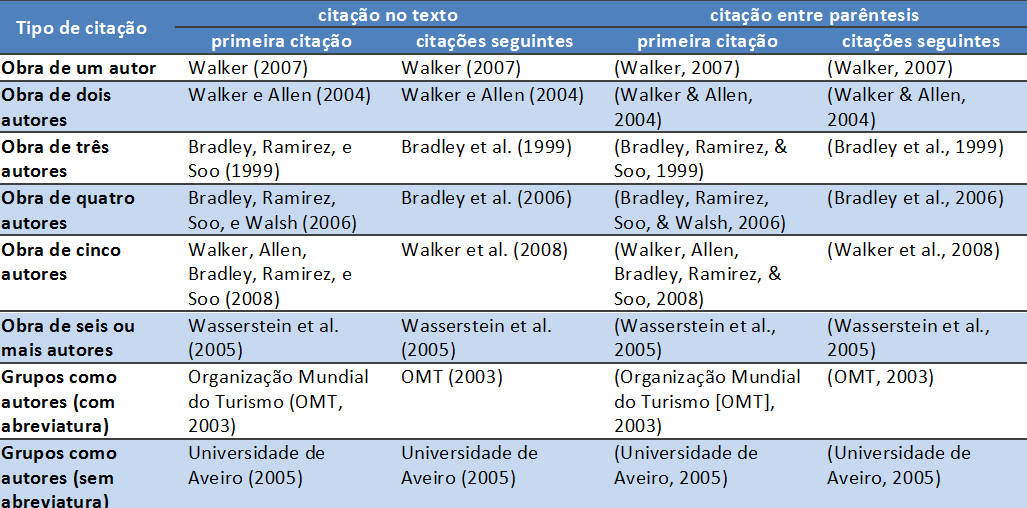
As citações devem seguir as normas da American Psychological Association (APA 6ª edição, 2010), conforme os seguintes exemplos:
7. Referências bibliográficas – As referências bibliográficas (e não apenas referências ou bibliografia), apresentadas de forma alfabeticamente ordenada no final do trabalho, devem obedecer às regras do formato APA – American Psychological Association (http://www.apastyle.org/) e conter todos os autores citados no texto. A lista de referências bibliográficas não deverá exceder trinta títulos.
Os títulos dos trabalhos não devem ser escritos em maiúsculas, exceto no seu início ou quando forem utilizadas palavras cuja regra assim o exija. Se tiver subtítulo, separar por ‘:’ e iniciar a primeira palavra do subtítulo com maiúscula. A exceção são os nomes dos journals, que são sempre iniciados por maiúscula (ex.: Pizam, A. (1999). A comprehensive approach to classifying acts of crime and violence at tourism destinations. Journal of Travel Research, 38(1), 5-12.). Caso os documentos possuam DOI (Digital Object Identifier) este deve ser apresentado na referência.
A lista de referências deve ser organizada, em termos de formatação, com tabulação nas linhas de baixo, e sem espaços. Alguns exemplos:
Livro
O'Connor, P., & Buhalis, D. (1999). Electronic information distribution in tourism & hospitality (2nd ed.). Oxford: CAB.
Artigo em publicação periódica científica
Buhalis, D. (1998). Strategic use of information technologies in the tourism industry. Tourism Management, 19(3), 409-423. DOI: 10.1016/S0261-5177(98)00038-7
Capítulo de livro
Breda, Z., & Costa, C. (2005). Safety and security issues affecting inbound tourism in the People’s Republic of China. In Y. Mansfeld & A. Pizam (Eds.), Tourism, safety and security: From theory to practice (2nd ed., pp. 187-208). Amsterdam: Elsevier Butterworth-Heinemann.
Documento online
Forrester. (1999). On line travel bookings. Acedido em 17 de janeiro de 2000, em http://www.forrester.com
Artigo em livro de atas de congresso (Proceedings)
Lowry, L. (1993). Sun, Sand, Sea. In K. Chon (Ed.), The Society of Travel and Tourism Educators. (Proceedings of Research and Academic Papers, Vol. V, Annual Conference, October 14-17, pp.16-28). Miami.
Tese
Gilbert, D. (1992). A study of the factors of consumer behaviour related to overseas holidays from the UK. PhD thesis, University of Surrey, Guildford, UK.
8. Agradecimentos – Colocar numa secção separada no final do artigo, antes das referências. Esta secção deve apenas ser incluida na versão final do artigo, após a sua aceitação para publicação, e nunca na versão sujeita a revisão.